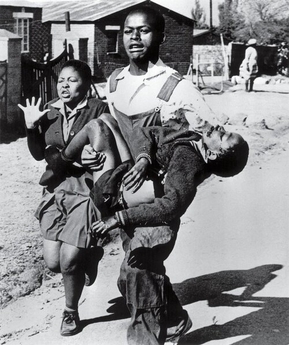
Hector Pieterson became the subject of an iconic image of the 1976 Soweto uprising in South Africa. The dying Hector is being carried by a fellow student, a photo which would be circulated around the world. He was killed at the age of 12 when the police opened fire on protesting students. For years, June 16th stood as a symbol of resistance to the brutali
ty of the apartheid government. Today, it is known as National Youth Day — when South Africans honor young people and bring attention to their needs.

Sunday, September 19, 2010
South Africa's Apartheid
I find it very difficult to put into words how utterly devastating the system of Apartheid was and the negative impact it had on the lives of the blacks and coloreds in South Africa. But out of the destruction came those freedom fighters who took a non-violent approach to fight for justice. We should all take a lesson from history from these individuals who were socially and economically depressed by their own government, but who didn't fight back with force, but rather with knowledge and peaceful uprisings.
It wasn't until 1994, just 16 years ago that apartheid came to an end in South Africa. Those I spoke with said that the scars that apartheid left will take generations heal.
Political History of Malawi
For the history buffs out there...
The British arrive in the region in 1858 because of the slave trade.
Independence from the British- Nyasaland becomes independent on July 6th 1964, taking the name Malawi. Banda retains his post as prime minister.
From the start of what turns out to be a 30-year rule in Malawi, Banda follows policies which are at odds with other African leaders in the newly independent nations. He maintains cordial relations with the repressive white-supremacist regimes of the southern continent, South Africa. Within months of independence several members of his cabinet resign - partly on this issue, and partly in protest at the autocratic style of government which Banda adopts from the start. Little will change over the years in either respect.
In 1965 two of his ex-ministers lead a rebellion against him. It fails, and the following year Banda transforms Malawi into a republic with himself as president - a post which in 1971 he claims for life. He runs the country as a one-party state, with ferocious persecution of anyone showing signs of disagreement with his policies.
An exceptionally low turn-out for elections in 1992 coincides with pressure from international loan agencies for the introduction of multiparty democracy. The eventual result, after strong opposition from Banda and his MCP, is new elections in 1994.
In spite of reported violence and intimidation by the MCP, the main opposition presidential candidate, Bakili Muluzi, is elected. His party, the United Democratic Front, also has the largest number of seats in parliament.
In 1995 Banda is arrested and is charged with the murder, ten years previously, of three former cabinet colleagues. He is acquitted and dies in retirement, in 1997, at the age of ninety-five.
In the second half of the 1990s President Muluzi makes considerable progress in improving Malawi's economy, particularly in terms of controlling inflation. This brings a much needed increase in foreign investment and aid.
The British arrive in the region in 1858 because of the slave trade.
Independence from the British- Nyasaland becomes independent on July 6th 1964, taking the name Malawi. Banda retains his post as prime minister.
From the start of what turns out to be a 30-year rule in Malawi, Banda follows policies which are at odds with other African leaders in the newly independent nations. He maintains cordial relations with the repressive white-supremacist regimes of the southern continent, South Africa. Within months of independence several members of his cabinet resign - partly on this issue, and partly in protest at the autocratic style of government which Banda adopts from the start. Little will change over the years in either respect.
In 1965 two of his ex-ministers lead a rebellion against him. It fails, and the following year Banda transforms Malawi into a republic with himself as president - a post which in 1971 he claims for life. He runs the country as a one-party state, with ferocious persecution of anyone showing signs of disagreement with his policies.
An exceptionally low turn-out for elections in 1992 coincides with pressure from international loan agencies for the introduction of multiparty democracy. The eventual result, after strong opposition from Banda and his MCP, is new elections in 1994.
In spite of reported violence and intimidation by the MCP, the main opposition presidential candidate, Bakili Muluzi, is elected. His party, the United Democratic Front, also has the largest number of seats in parliament.
In 1995 Banda is arrested and is charged with the murder, ten years previously, of three former cabinet colleagues. He is acquitted and dies in retirement, in 1997, at the age of ninety-five.
In the second half of the 1990s President Muluzi makes considerable progress in improving Malawi's economy, particularly in terms of controlling inflation. This brings a much needed increase in foreign investment and aid.
Fun Malawi Facts
Language
English is Malawi's official language and is widely spoken, particulary in main towns, but sometimes also in remote rural areas.
Chichewa, is the common national tongue widely used throughout the country where, from 1968 until recently, it has served as the national language.
Hello- moni
How are you?- muli bwanji
I am fine- ndiri bwino
Thank you- Zikomo
Food
The staple diet is white maize eaten with vegetables and, on occasion, fish or meat.
Nsima- Staple Food - eaten with your hands, it is a
ground maize
Malawian Desserts include:
Nthochi (banana bread)
Mtedza (peanut cookies)
Zitumbuwa (banana fritters)
English is Malawi's official language and is widely spoken, particulary in main towns, but sometimes also in remote rural areas.
Chichewa, is the common national tongue widely used throughout the country where, from 1968 until recently, it has served as the national language.
Hello- moni
How are you?- muli bwanji
I am fine- ndiri bwino
Thank you- Zikomo
Food
The staple diet is white maize eaten with vegetables and, on occasion, fish or meat.
Nsima- Staple Food - eaten with your hands, it is a
Malawian Desserts include:
Nthochi (banana bread)
Mtedza (peanut cookies)
Zitumbuwa (banana fritters)
Our Exit from Malawi
Along the road we saw men making gravel with large rocks and picks. Road workers painting the street lines by hand with string. Boys selling hand carved toy bikes and trucks. There were many police stops checking for expired registrations and a little extra cash :). There were many termite hills exceeding 5ft tall. There were potatoes for sale, whole hanging goats, mice kabobs, tomatoes, strawberries, apples and blackberries. There was so much going on around us it made the car rides just fly by.
Saturday, September 18, 2010
Mua Mission
As our visit to Malawi wound down we spent our final night, Thurs. Sept 2nd, at Mua Mission. The mission is run by a French order of Roman Catholic priests called the "White Fathers". The name came from the color of their robes and not their skin.
The mission is located in the great rift valley and consists of a church, school, hospital and a surrounding village, all nestled in the side of a mountain. Our rondovals were identified by a mask rather than a room number.
There was also a museum broken down into 3 parts. The first section told the story of how Christianity was introduced in Malawi, starting with the exploration of the region by Dr. David Livingstone, from there the advent of the White Fathers.
The second section of the museum housed beautiful masks, costumes, and artifacts of the 3 primary tribal groups that live in Malawi; the Chewa, Ngoni, and the Yeo, all 3 are Bantu tribes.
And the final section spoke of the history of the 3 primary bantu tribes inhabiting the area. The Chewa and the Ngoni came into the area less than 150 years ago after fleeing the KwaZulu area of Natal, South Africa. The Yao settled in the south and around the lake and were heavily influenced by the Muslim traders there. They converted to Islam and sold their African brothers to slave traders in the Middle East until the British took over the area and stopped the slave trade. And in current day Malawi, most Muslims are of Yao descent.
Another highlight of the mission was the wood carving. In 1976 a priest decided to develop this indigenous craft to make a difference in the economic condition of the area. A large group of craftsmen are now able to support their families through the sale of their work done through Mua Mission. Many of the carvings seen in Lilongwe come from Mua but they cost much less at the mission. They are beautifully done and ridiculously cheap by American standards. How I wish I had more room in my suitcase!
Subscribe to:
Posts (Atom)